Trusted Beats Smart. Here's How Sovereign AI Raises the Bar for Healthcare.
Most AI conversations in healthcare hit the same wall: the business wants ChatGPT-speed, IT and Compliance want zero data egress. The answer is neither full cloud SaaS nor building from scratch — it's sovereign, open-weight AI you actually own.
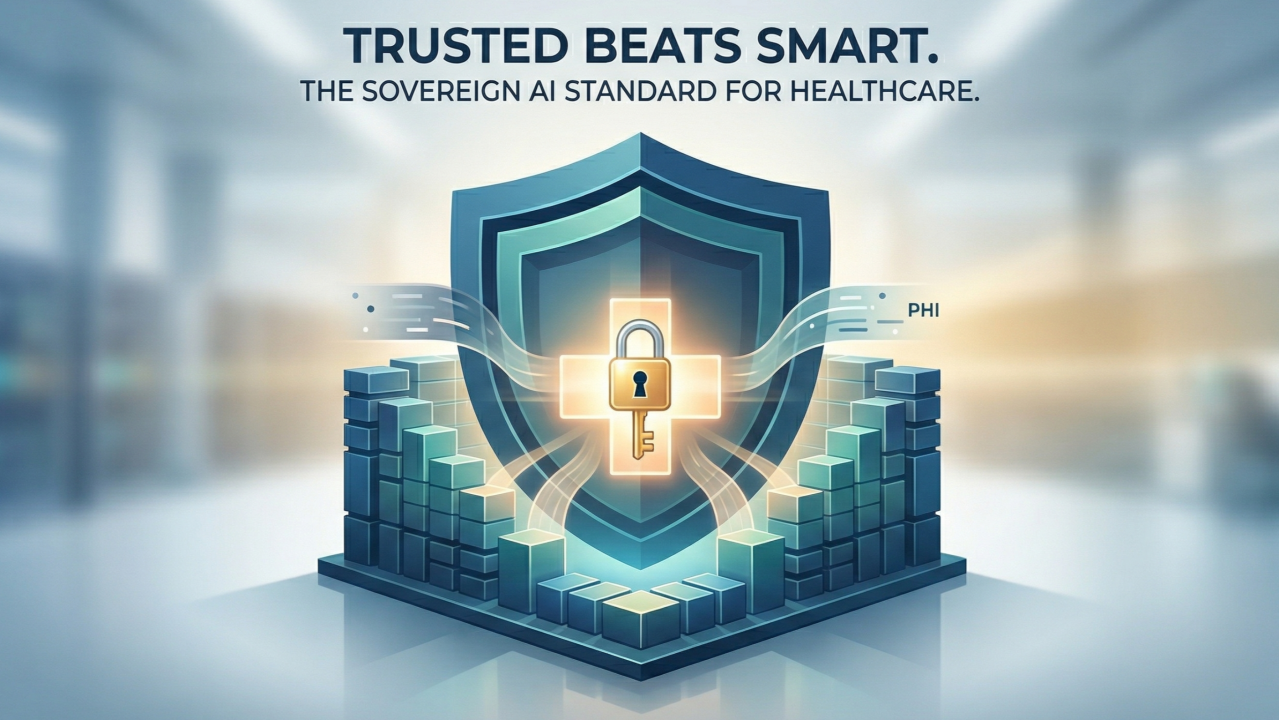
Most AI conversations in healthcare operations hit the same wall.
The business wants the speed and capability of tools like ChatGPT. IT and Compliance want nothing to do with a system where patient data could leave the building. The result is a standoff. And in the standoff, nothing gets built.
ZuzeTech’s AI Governance Matrix was designed to help organizations find a way through. The answer is neither full cloud SaaS nor building everything from scratch. It is a third option: an open-weight foundation model, fine-tuned on your proprietary data, deployed in your own infrastructure.
Here’s why that combination wins on every dimension that matters to a CIO.
The sovereignty problem isn’t theoretical
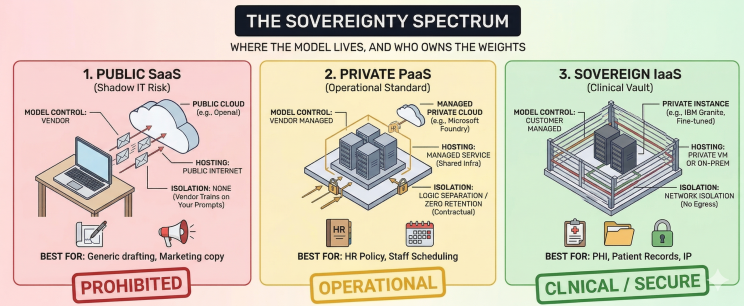
Our framework classifies AI deployments across three zones.
Zone 1 covers public SaaS products like ChatGPT. They offer speed and ease, but the tradeoff is disqualifying for clinical workflows. The vendor trains on your prompts, data isolation is contractual at best, and you have no control over the model itself.
Zone 2 covers private PaaS deployments, such as Azure-hosted models with zero data retention agreements. This is the operational standard for non-clinical workflows: logic separation, managed isolation, and contractual protections. It’s where most enterprise AI activity legitimately lives.
Zone 3 is sovereign IaaS, and it’s where PHI, patient records, and proprietary intellectual property belong. Customer-managed model weights, private instances, and network isolation with no egress. This is the clinical vault.
The mistake most healthcare organizations make is assuming Zone 3 requires building a model from zero. It doesn’t. Open-weight models like IBM’s Granite change the equation entirely.
Why open foundation models are the right starting point
When you start with an open foundation model, you inherit years of general language capability and then specialize it on your data — your clinical documentation patterns, your ticket routing history, your extracted form data. The result is a model that is both smaller and more accurate for your specific workflows than any general-purpose API could be.
Not all open models are equal, and for healthcare CIOs the distinction matters. Most models described as “open source” release only their weights, meaning the trained parameters, without disclosing what data they were trained on or how. This matters beyond semantics. Without visibility into training data, you cannot audit for bias, screen for PHI leakage in the training corpus, or defend your model choices to regulators.
Models like IBM Granite and NVIDIA Nemotron represent a higher standard:
- Transparency — full disclosure of training data sources, so you know what shaped the model’s behavior
- Auditability — reproducible training recipes that can be reviewed, challenged, and documented for legal defense
- Bias & safety checks — open data enables screening for PHI leakage and demographic bias before deployment, not after
- Efficiency — high task performance at a fraction of the cost of proprietary alternatives
For an industry where auditability is a compliance requirement, not a preference, that transparency is the difference between a model you can defend to your legal team and one you can’t.
This is why model selection deserves the same rigor as vendor selection. Our Sovereignty Spectrum addresses where a model lives. The training transparency question addresses what’s inside it. Both checkpoints belong in any serious AI governance process.
The long-term cost logic
At early usage volumes, per-token API costs feel manageable. At scale, they compound in ways that are difficult to predict in advance. Furthermore, you’re paying them indefinitely, with no leverage over the pricing. A fine-tuned open model converts that variable cost into a one-time investment, with inference running on your own compute. The economics cross over faster than most finance teams expect.
More importantly, you avoid the vendor lock-in dynamic entirely. When a proprietary API changes its terms, its pricing, or its model behavior, your clinical workflows don’t change with it.
The cost argument is backed by performance data, not just theory.
Recent benchmarks (Fulton, IBM Dev Day 2026) show that Granite 8b — paired with structured agentic programming patterns — matched or exceeded the accuracy of Llama 70b on complex compliance and database agent tasks. The takeaway: you don’t need a massive, general-purpose black box to handle healthcare workflows. You need a right-sized, transparent model you actually own.
Source: “Generative Programming with Mellea,” Nathan Fulton, IBM Dev Day, January 2026.
The “Model Fit” question every organization should ask
One of the most common mistakes we see is using a massive, general-purpose model for tasks that a smaller, specialized model would do better and cheaper. Our framework calls this the “Model Fit” check, i.e. don’t use a cannon to kill a mosquito.
Fine-tuning Granite on ten thousand historical support tickets produces a more accurate routing model and a more efficient one with lower latency, lower compute cost, and a tighter audit trail. For healthcare organizations where every workflow has a compliance dimension, that combination of efficiency and explainability is genuinely valuable.
The operational excellence standard
There is a meaningful difference between a system that is “smart” and one that is “trusted.” Smart systems impress in demos. Trusted systems pass your CISO’s sovereignty check, survive a compliance audit, inherit user-level permissions correctly, and fail gracefully when they don’t know the answer.
The open model fine-tuning path is not the fastest way to stand up an AI demo. However, it is the most direct path to a system your organization can actually depend on — a system where you own the weights, control the data, and can explain every architectural decision to your board and your regulators.
That’s the standard healthcare CIOs should be holding every AI initiative to.
Where do you stand?
The organizations that will define the next decade of healthcare operations are not the ones that moved fastest to adopt AI. Instead, they are the ones that built systems their staff, their patients, and their regulators can actually trust. The open model fine-tuning path is how you get there. This gives you a sovereign infrastructure, transparent foundations, and purpose-built intelligence that gets sharper as your data grows.
So here is the question worth bringing to your next AI steering committee: where does your organization sit on the sovereignty spectrum today, and what is the single biggest barrier stopping you from moving toward Zone 3?
If this challenge is on your 2026 roadmap, ZuzeTech’s Executive AI Governance Matrix is a free resource designed to structure that conversation — from vendor selection to safety checklists to deployment architecture. Download the Executive AI Governance Matrix.
Originally published on LinkedIn.
References
- ZuzeTech Executive AI Governance Matrix: Download
- “Generative Programming with Mellea,” Nathan Fulton, IBM Dev Day, January 2026.
Originally published at https://www.linkedin.com/pulse/trusted-beats-smart-heres-how-sovereign-ai-raises-bar-daliso-zuze-j5tpe.